
Attendance Policies
This is the Attendance Policy page. Here, organizations can define their SOPs for attendance rules. This means the organization can configure when deductions are applied, when overtime is rewarded, and how special situations like partial day attendance are handled.
Now let's start by creating an attendance policy.
Basic Policy Configuration:
- Enter the name of the policy.
- Select (Yes/ No) if this policy is applicable on National Holidays, Festival Leave, or Other Holiday Leave.
- Optionally add an Overtime Label which will be used to display overtime values in salary management and salary slips.
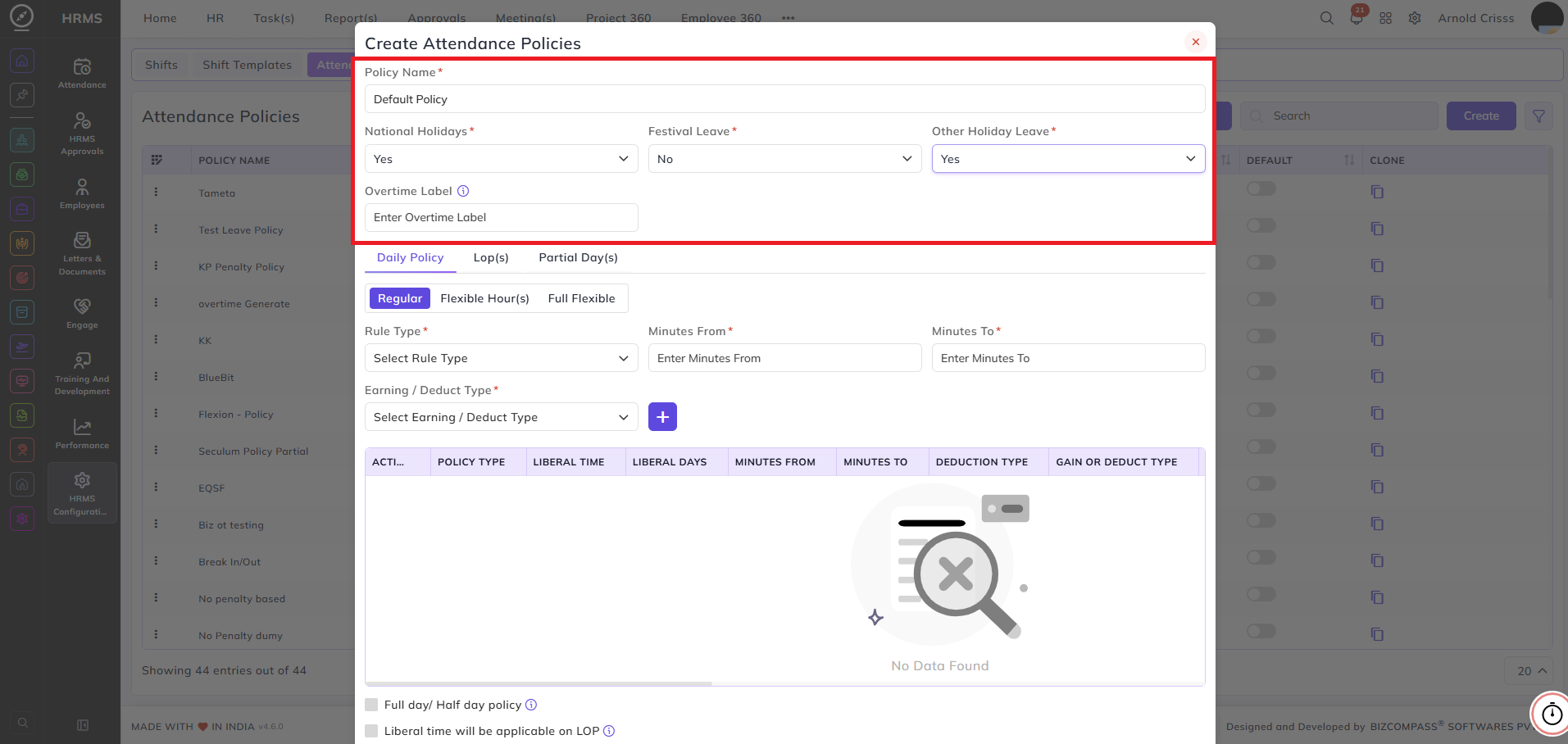
There are three main components in the attendance policy:
-
Daily Policy
-
LOP (Loss of Pay)
-
Partial Day
1. Daily Policy:
In the Daily Policy, the organization can define the regular working day rules such as the required working hours. If an employee arrives late, the corresponding deduction can be applied. The organization can also define a grace period for late arrival. If an employee works more than the defined working hours, then overtime can be generated automatically.
In the Daily Policy there are three types:
-
Regular
-
Flexible Hours
-
Full Flexible
- In the Regular type, the organization defines the rules for early and late clock-in and clock-out behavior.
- In the Flexible Hours type, there is no need to define early or late clock-in or clock-out rules. Instead, the system only checks whether the employee has worked more than the required working hours. If they do, overtime will be generated automatically.
- The Full Flexible type does not apply deductions or overtime rules. This is typically used for CXOs, CEOs, and top-level management, where attendance is not strictly monitored.
Now let's start with the Regular policy configuration.
In the Regular policy, the organization can define both earnable types and deductible types.
There are three earnable types:
-
Early Clock In
-
Late Clock Out
-
Out of Shift
There are three deductible types:
-
Early Clock Out
-
Late Clock In
-
Special Penalty
Now each of these types can be configured step by step.
Early Clock In (Earnable):
Early Clock In means if an employee arrives before the shift start time, they can receive overtime for that duration.
For this configuration we define:
-
Minutes From
-
Minutes To
These fields define the minimum and maximum overtime limits.
For example:
Minimum = 1 minute
Maximum = 120 minutes
- If the employee arrives at 8:59 AM, they will receive overtime for that 1 minute.
- If the employee arrives extremely early, for example at 6:00 AM, they will still receive overtime only up to the maximum limit of 120 minutes.
- So even if the employee arrives very early, the maximum payable overtime will be 120 minutes, along with the regular working hours of the day.
There are three earning types that define how overtime is calculated.
- Time Wages: where the overtime amount is calculated based on the employee's hourly rate.
- Amount: A fixed amount is paid to the employee for overtime, regardless of hours worked.
- Attendance: Overtime is compensated according to attendance, such as a full day, half day, or quarter day.
Let's take Time Wages as an overtime type.
- The organization can also define a multiplier for overtime. For example, if overtime should be paid twice the hourly rate, then a multiplier value can be defined.
- Fractional multipliers can also be used.
For example:
- Early Clock In is earnable from minimum 1 minute to maximum 120 minutes with an earning type of time wages and a multiplier of 2.
Overtime Starts After In Minutes:
This defines the minimum time an employee must arrive early before overtime begins.
- For example, if overtime starts after 60 minutes, then the employee must arrive at least 60 minutes before shift start for overtime to be counted.
- If the employee arrives at 8:01 AM, which is 59 minutes before the shift, then it does not satisfy the overtime start condition, so no overtime is counted.
- If the employee arrives at 7:59 AM, then it becomes 61 minutes before the shift, and overtime will be counted.
Overtime for Each Minute:
Overtime can be paid in slots instead of exact minutes.
For example, if overtime is provided for each 30 minutes, then overtime will only be paid for completed 30-minute slots.
If the employee works 75 minutes overtime, it will be divided into:
-
First 30 minutes
-
Second 30 minutes
-
Remaining 15 minutes
The employee will be paid only for 60 minutes, because the remaining 15 minutes does not complete the slot requirement.
Consider in Regular:
If this option is enabled, then early arrival time may be counted as part of regular working hours instead of overtime.
For example, if an employee arrives 10 minutes early at 8:50 AM and later wants to leave 10 minutes early, the early arrival can compensate for the early leave within regular working hours.
Late Clock Out (Earnable):
For Late Clock Out we again define:
-
Minimum minutes
-
Maximum minutes
-
Multiplier
There are also two additional fields:
-
Liberal Time
-
Liberal Days
Liberal Time means that within a certain duration, overtime may not be paid for a limited number of days.
For example:
Minimum overtime = 1 minute
Maximum overtime = 240 minutesIf an employee leaves at 6:10 PM, they will receive 10 minutes overtime.
But suppose the organization defines:
Liberal Time = 0 to 60 minutes
Liberal Days = 3
This means that for the first three days, if the employee stays late within 0 to 60 minutes, overtime will not be paid.
For example:
Day 1 → Leaves at 6:15 PM → within liberal time → not paid
Day 2 → Leaves at 6:30 PM → within liberal time → not paid
Day 3 → Leaves at 6:50 PM → within liberal time → not paidAfter the liberal days are exhausted, overtime will start being paid.
If the employee leaves at 6:15 PM on the fourth day, they will receive 15 minutes overtime.
If the employee leaves at 7:01 PM, which is 61 minutes after shift, it falls outside the liberal range and overtime will be paid even if liberal days are still available(example person leave at 7:01 PM on first day still get Paid for Overtime).
Out of Shift (Earnable):
Out of Shift means that the employee works completely outside the shift timing.
- For example, if an employee clocks in at 2 AM and clocks out at 4 AM, then the entire 120 minutes will be counted as overtime.
The organization can apply a multiplier here as well.
Early Clock Out (Deductible):
Early Clock Out means the employee leaves before the shift end time.
The deduction can be applied in three forms:
-
Time Wages
-
Attendance Deduction
-
Fixed Amount
If time wages are used, then deduction will be calculated based on the employee's hourly rate.
Minutes From and Minutes To define the deduction range.
For example:
Minimum = 60 minutes
Maximum = 540 minutes
If an employee leaves anytime within this range before the shift ends, it will be considered as Early Clock Out deduction.
Late Clock In (Deductible):
Late clock in also has Liberal Time and Liberal Days.
For example:
- Late clock in starts after 60 minutes.
- If the employee arrives at 9:50 AM or 9:59 AM, they are still not considered late because late deduction starts only after 60 minutes.
- If the employee arrives at 10:15 AM, it becomes the first late count.
- If there are 3 liberal days, the employee will not be deducted during those three late arrivals.
Example:
Day 1 → Arrives 10:15 AM → liberal day used → no deduction
Day 2 → Arrives 10:20 AM → liberal day used → no deduction
Day 3 → Arrives 10:30 AM → liberal day used → no deductionAfter these liberal days are completed, late arrivals will start generating deductions.
Special Penalty (Deductible):
Special penalty is applied when repeated late arrivals happen even after liberal limits.
Special penalty also has:
-
Liberal time
-
Liberal days
-
Minutes from
-
Minutes to
There are two modes for Deduction Type:
-
Deduction After Each Liberal Days
-
Deduction Each After Liberal Days
- In After Each Liberal Days, penalty starts after liberal days are completed and the incremental amount will increase everyday after first day of penalty applied.
- In Each After Liberal Days, penalties are applied after liberal days and the incremental amount will be given in slot cycles.
For example:
First 3 days → no deduction
Next 3 days → penalty applies
Special penalty deduction types can be:
-
-
Amount
-
Attendance
-
Time wages
-
If amount is selected, the system also allows incremental value.
Example:
Day 3 late arrival → ₹100 deduction
Day 4 late arrival → ₹150 deductionTotal deduction becomes ₹250.
- There is an option Do Not Pay Overtime If Applied. If special penalty is applied, overtime will not be generated for that day.
- There is also Special Penalty Based on Approval, where HR approval may be required before applying the penalty.
- Another option is Special Penalty Cut Within Regular Hours.
For example, if an employee arrives 70 minutes late but compensates by staying 70 minutes late after shift, the penalty may be avoided if this option is enabled.
Full Day Pay Rule:
Generate Overtime If Present More Than Shift Hours:
If enabled, the employee will receive full day pay even if only one clock-in and clock-out log exists, even if the duration is very small.
Liberal Time will be applicable on LOP:
If selected, deducted minutes under liberal time will be added back. For example, if 30 minutes are allowed and someone is 30 minutes late, those 30 minutes will be counted in present hours when calculating LOP.If this option is enabled, overtime becomes Flexible and for that need to select overtime type as Flexible.
Early clock-in and late clock-out configurations are removed, and overtime is calculated simply when total working time exceeds shift duration.
Overtime Types can include:
Early Clock In
Late Clock Out
Flexible
Week Off OT
Holiday OT
Out of Shift OT
The organization can select which overtime types should generate payment.
Break Time Configuration:
Assume shift duration is 9 AM to 6 PM, which is 9 hours.
Out of these:
8 hours = working time
1 hour = break timeThe system provides multiple break calculation options.
- First option is Calculate Break Time Based on Break Logs.
- If the employee does not add break logs, the employee will be paid for full shift duration.
- If break logs are added, the break duration will be deducted from working hours.
Example:
- Employee arrives 9 AM
- Break 11:00 AM to 11:30 AM
- Leaves 6 PM
- Total break = 30 minutes
- Working hours = 8 hours 30 minutes
If Consider First and Last Log is enabled:
First log = 9 AM
Last log = 6 PM
Total working time becomes 9 hours.Next options are:
Cut Break on Holiday
Cut Break on Week Off
If enabled, break duration will also be deducted from overtime worked on holidays or week offs.
Another option is Consider Break in Regular.
- If employees take breaks during early arrival or late overtime periods, those break durations will still be counted as working time.
2. LOP (Loss of Pay):
In LOP, the organization can define that if an employee does not complete the required working hours on a daily, weekly, or monthly basis, deductions can be applied or attendance can be calculated accordingly.
For example, if an employee does not complete 75% of the daily working hours, then the attendance can be considered as half day.
Now let's understand LOP calculations.
LOP can be calculated based on Daily, Weekly, or Monthly period. It will only allow a single type of time period within an attendance policy. (For example, if a "Daily" rule is added, all subsequent rules must be added using the Daily rule. The policy cannot include rules for Monthly or Weekly)
For example:
If 85% weekly hours are not completed, then 1 day deduction may apply.
Example:
Regular day = 8 hours
5 working days = 40 hours
85% of 40 hours = 34 hoursIf the employee works less than 34 hours in the week, a deduction of 1 day (8 hours) may apply.
Ignore Leave Hours During Shift Hours Calculation:
Example:
- Employee takes leave on Wednesday.
- Instead of calculating weekly hours based on 40 hours, the system recalculates based on 32 hours for the remaining 4 working days.
- So 85% will be calculated on 32 hours instead of 40 hours.
3. Partial Day:
- The third component is Partial Day.
- Sometimes employees may arrive late or may face unexpected conditions. In such situations, based on the Daily Policy and LOP rules, they might get deductions.
- Instead of receiving deductions through the daily policy or LOP, the employee can apply for a Partial Day.
- Using Partial Day, the employee is allowed to request permission so that they can avoid deductions and still get paid for that time.
- Partial Day must first be enabled in the attendance policy.
Allowed Count:
Allowed count defines how many times an employee can apply partial day.
Allowed type can be:
-
Count
-
Minutes
For example:
Allowed Count = 1 per week
This means the employee can apply one partial day per week.
Max Late Arrival Minute(s) Per Request:
Example:
- Maximum late arrival allowed = 60 minutes
- Employee cannot request partial day if they are late beyond 60 minutes.
Max Early Departure Minute(s) Per Request:
Example:
- Maximum early leave allowed = 30 minutes.
- If the employee leaves earlier than 30 minutes, partial day cannot be applied.
Max Absence of Minute(s) Per Request:
This covers situations where employees clock out and clock back in during the shift.
Example:
Employee:
- Clock in 9 AM
- Clock out 11 AM
- Clock in 12 PM
Absence = 1 hour
If maximum absence allowed is 60 minutes, they can apply partial day for that absence.
Apply Before Days:
This controls how early the partial day request can be applied.
| Value | Allowed Leave Dates |
|---|---|
| 0 | Past, present, and future dates |
| 1 | From today onward (Present and Future) |
| 2 | From tomorrow onward |
| 3 | From day after tomorrow onward |
Restrict Past Days Setting:
Example:
- Past request allowed = 5 days
Employee can apply partial day for up to 5 days in the past.
Restrict Request After Days:
Example:
- If restriction date is 26, employees cannot apply partial day after the 26th date even if they still have remaining counts.
Reason Required:
If enabled, employees must enter a reason while applying partial day.